AI in February 2026: What I'm seeing in the wild
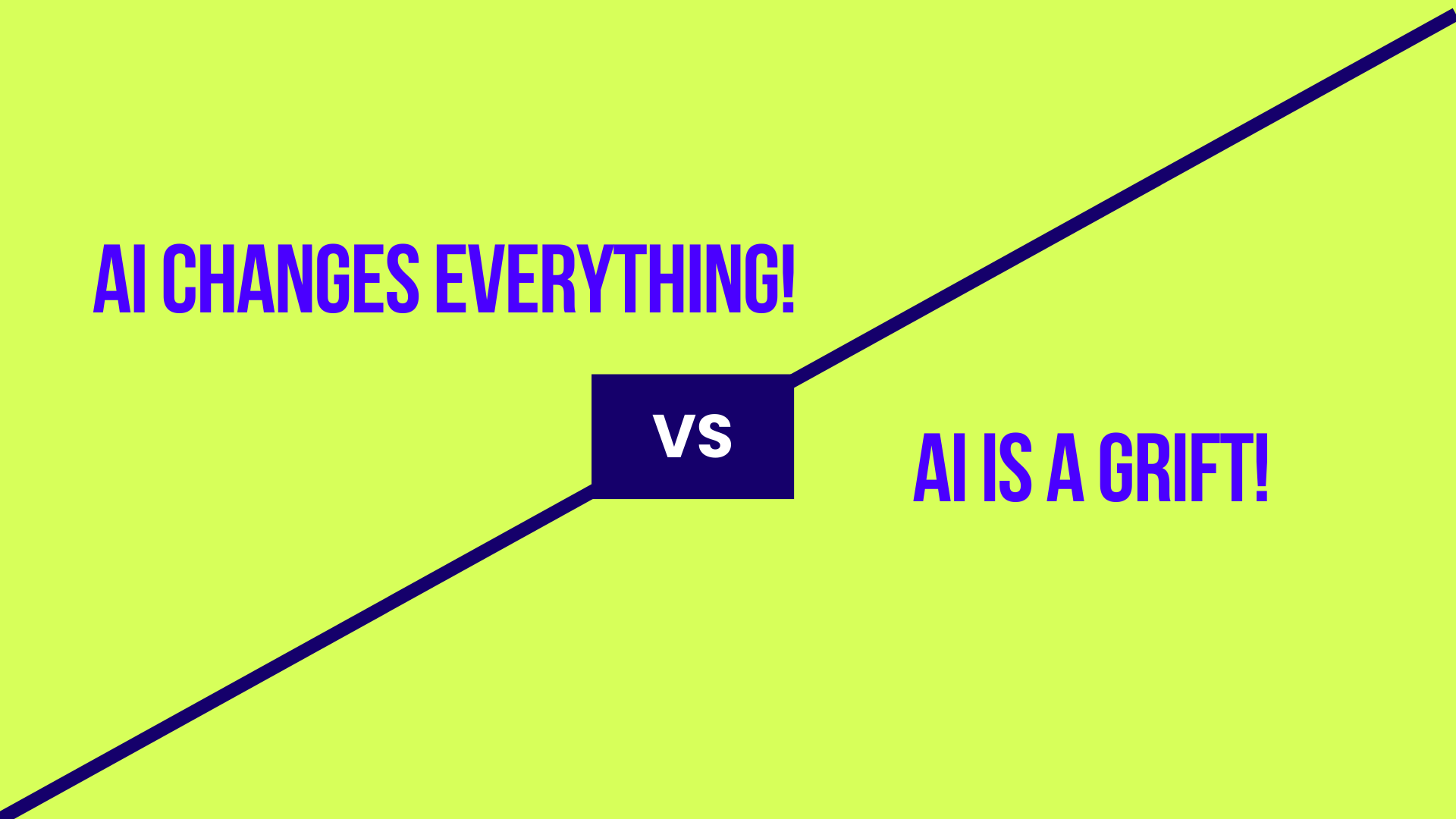
Half of my LinkedIn feed says AI instantly gives you a team of 50 people. And that they’ve just made [fill in a very specific high amount] in [an unbelievably short period of time]. Or that we should prepare for 50% fewer white-collar jobs in 3 years.
The other half says AI is the biggest grift there has ever been. The models are so stupid they can’t even write an email. The em-dashes! Can’t do a simple calculation! Tells me I should walk to the car wash! Just you wait until the great bubble pops and you’ll be rubbing your eyes incredulously.
It almost seems like neither side actually tried to assess the tools at face value. There is a good amount of experimentation needed to see how mature AI-enabled tools and GenAI platforms really are. What was true about a year ago is not always true today.
My takes on AI below, with a primary focus on a business context.
AI for individual use
Coding
Some models are really good at coding. They can produce and review code at a high quality. As long as you have an eye on the output and can steer them correctly, producing working software has become faster. Prototyping has become MUCH faster, and I firmly believe many projects covering operational processes or software with a user interface benefit from some form of AI-assisted prototyping.
You still need Security Engineering and Architecture skills, and more than ever, a clear rationale for what to build, when NOT to build, and how to know if what you build actually works.
Data Analysis
The same applies to data analysis. It’s astonishing how far the capabilities have increased.
If you can assess what analyses should be performed, have a good grasp of data models, and enough subject matter expertise to verify approach and output — AI can be a fantastic sidekick throughout the process. Querying, cleaning, transforming, analyzing, and visualizing. Applied to your processes and tooling, it’s genuinely changed how you can do data analysis compared to a few years ago.
Personal Productivity
In my opinion, the personal productivity hype is overblown. We’re not at a point where everyone has personal assistants ready at their disposal. Maybe the Clawdbot / Moltbot / Openclaw experiments will change that, but not as of mid-February 2026.
The caveat: If you already had a working system for task management and prioritization, AI does add a productivity multiplier. There are some convenience features, but I don’t personally see the big productivity boost some claim.
Thinking / Reasoning
Using AI as a thinking sparring partner — this is where current models really shine. As long as you come prepared with thoughts, hypotheses, and questions, the models’ reframing is incredibly helpful. The same is of course true if you speak to a competent colleague and brainstorm in front of a whiteboard. I still prefer that any day of the week. Unfortunately, they’re not available on demand — especially the competent ones. AI gives you a good alternative, though.
Content Creation
The most obvious one last. Yes, GenAI generates content. If your bar isn’t insanely high — expecting the level of copy editing and image generation a professional would deliver — it does a passable job.
I use AI primarily to summarize, correct, and translate rather than to produce content for publishing. Iterating, structuring, drafting, sure. But again, primarily with AI as a sparring partner.
AI in an organizational context
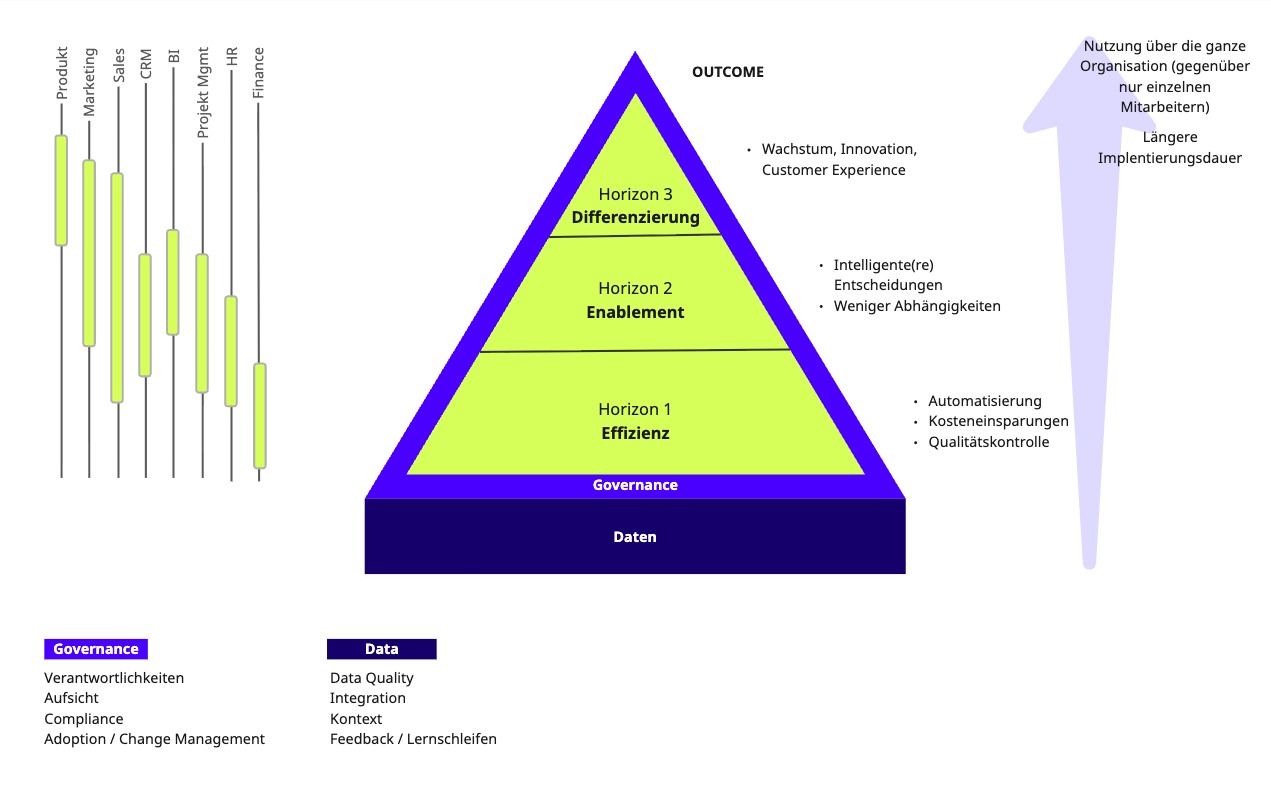
Organizationally, AI effectiveness mirrors the maturity, discipline, and governance of IT usage. If these were broken before, AI does not fix incomplete data, scattered knowledge management, or a fragmented tool landscape. Quite the opposite: AI exacerbates these shortcomings.
For those few organizations that have done their homework, I’m seeing productivity increases higher than what I would have expected.
The best examples I’ve seen repeatedly:
- Internal tools to assist with repetitive, high-volume, tedious tasks
- AI tools assisting customer support agents in their job
- Information and tooling for sales enablement
- Personalization in marketing communication
What the AI debate reveals again and again: AI amplifies existing competence and shortcomings. The ones reaping the benefits are the ones who know what “good” looks like and how they would do it themselves — individuals and organizations alike.
Curious what others see: Where did AI make a difference? Where did it fall short for you?
Share
About the Author